Gemini API
Gemini 4 Hydrogen replaces 3.8 Flash, with breaking changes
| Per 1M tokens | 3.8 Flash | Hydrogen |
|---|---|---|
| Input | $0.75 | $1.50 |
| Output | $3.75 | $7.50 |
| From Jan 1 | $1.50 / $7.50 | No dated change |
- What changed
Google released Gemini 4 Hydrogen on November 12, a fast model for agent and coding work. Its paid rate is double 3.8 Flash's today, but 3.8 Flash rises to the same price on January 1.
- Why it matters
The migration guide lists breaking changes:
temperature,top_p, andtop_kare gone, explicit caching isn't supported, the default thinking level moves to high, and input and output share one 1M-token window.- What to do
Move one 3.8 Flash workload in December, before both models cost the same. Remove sampling parameters and explicit cache calls, then compare output and cost at the new default thinking level.
GitHub Copilot
GitHub retires six Copilot models on December 14
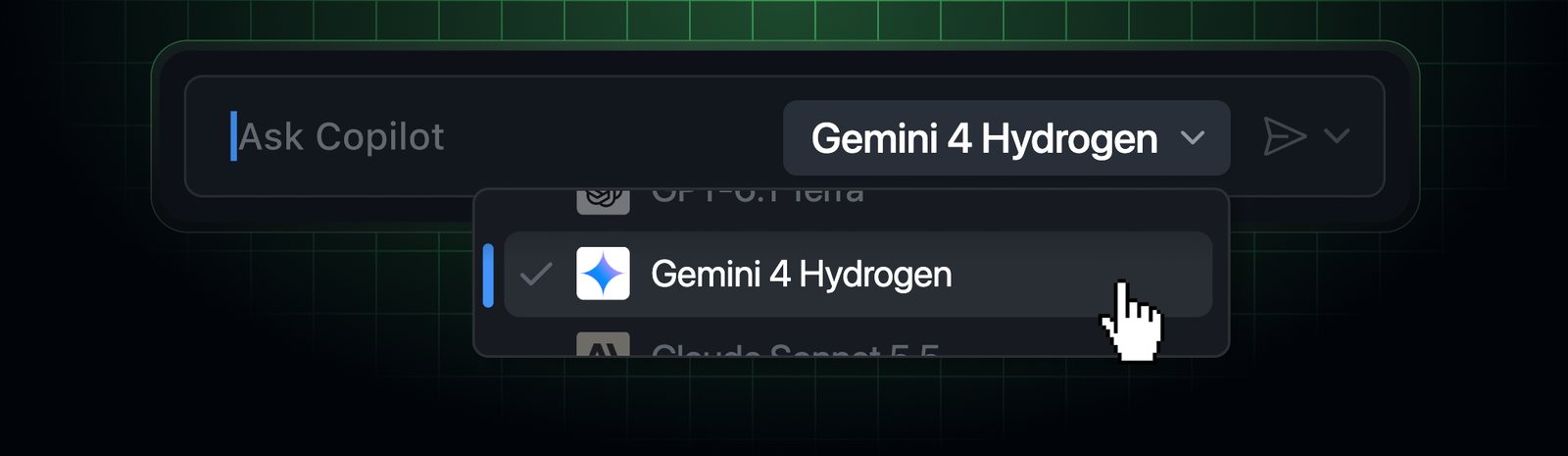
GitHub's release image shows Gemini 4 Hydrogen, the replacement for Gemini 3.8 Flash, in the Copilot model picker. View official source ↗
- What changed
GitHub will retire Claude Fable 5, Claude Haiku 4.5, Gemini 3.8 Flash, Gemini 4 Argon, Grok 4.6, and Kimi K3 across all Copilot experiences. Each has a named replacement except Kimi K3.
- Why it matters
Replacements turn on automatically for Business and Enterprise unless an admin turned off the global default. Some cost more at provider list price: Hydrogen is double 3.8 Flash's current rate, and Carbon doubles on December 1.
- What to do
Find workflows, agents, and SDK calls pinned to a retiring model. Switch them before December 14, and check usage-based billing for any team that defaults to Gemini models.
Cursor security
Cursor's breach started with a vendor key and secrets in agent traces
| Data | Exposed? |
|---|---|
| Stored agent traces | Some |
| Credentials in traces | Some |
| Privacy Mode data | No |
| Production systems | No |
| Customer repos | No |
- What changed
Cursor says an attacker used a key Cursor had issued to its inference vendor, Fireworks, which Fireworks exposed. It opened a shared bucket of stored agent traces, and credentials left in those traces led into Cursor's internal tools.
- Why it matters
Agent traces record what the agent saw, including tokens and keys pasted into a session. Stored without redaction, they work like a credential store that every vendor with bucket access can reach.
- What to do
If you're a Cursor admin, check whether you received a key list and rotate it. For your own agents, redact secrets before storing traces and review which vendors can read where you keep them.
Open weights
Inkling 2 Small's weights are out under Apache 2.0
| Spec | Inkling 2 Small |
|---|---|
| Parameters | 594B total, 17B active |
| Input | Text and images |
| License | Apache 2.0 |
- What changed
Thinking Machines published the weights for Inkling 2 Small on Hugging Face on November 12. It launched on November 5 as a hosted model on Thinking Machines' Tinker API.
- Why it matters
Apache 2.0 has no revenue threshold or hosted-service clause, unlike the custom licenses on several recent open-weight models. The model runs on vLLM, SGLang, Unsloth, and TokenSpeed.
- What to do
If you self-host, test it on one task where licensing has blocked other models. Measure quality and serving cost against your current API model before committing hardware.
AWS Bedrock
New AgentCore runtimes now start in under 2 seconds by default
| Runtime | V1 | V2 |
|---|---|---|
| Start time | 29.7 s | Under 2 s |
| Session size | Not stated | 8 vCPU, 32 GB |
| Idle agents | Not stated | Scale to zero |
- What changed
New runtimes in Amazon Bedrock AgentCore use the next-generation runtime by default in 19 regions. Each session restores from a snapshot of the initialized agent and still runs in its own Firecracker microVM.
- Why it matters
Existing runtimes stay on V1 until you set
platformVersionto V2. AWS says multi-turn agents use up to 68% less billed memory per session, but points to its pricing page for rates.- What to do
Move one existing runtime to V2 in a test account. Check that state restored from the snapshot behaves correctly, then compare start time and billed memory before moving the rest.
Also since the last issue
Useful updates
Shorter disclosure deadlines
Anthropic will give vendors 30 days to fix high and critical vulnerabilities it reports from January 1, and 45 days for others. The 7-day window for actively exploited bugs is unchanged.
EU impact assessment template
The European Commission published a draft template for AI Act fundamental rights impact assessments on November 16. Deployers can offer to test it by December 4; the obligation applies from December 2, 2027.
One workflow to try
Pin models before December 14
Search your Copilot settings, agent configs, and SDK code for the six retiring model names. Switch each to its replacement, run one known task, and note any change in output or cost.
Term of the week
Agent trace
An agent trace is the stored record of a session: prompts, tool calls, file contents, and outputs. It can capture any secret the agent saw. Treat stored traces like logs that may hold credentials, and redact them before keeping them.