This week’s read
Agent controls moved into the runtime
This week moved cost, policy, review depth, and measurement into the agent runtime.
Permissions, network boundaries, and acceptance tests still sit outside it.
Agentic engineering
Anthropic made long runs bounded before they start
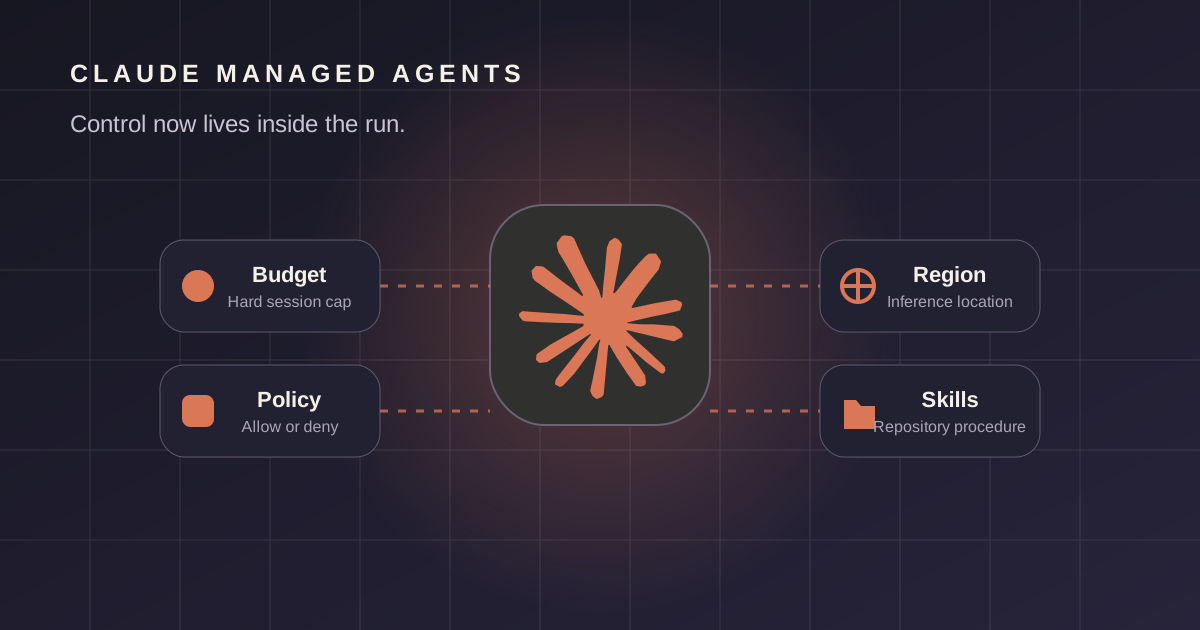
DVx control map based on Anthropic’s August 5 and August 7 release notes.
- What changed
On August 7, Claude Managed Agents added a hard session budget. At the cap, a session pauses before its next model request with
budget_reached, though an in-flight request finishes. Anthropic also added inference geography, repository skills, and an advisor. On August 5, Enterprise customers got beta hooks that hold governed prompts for an external allow or deny decision.- Why you should care
The runtime can enforce cost and prompt admission. It still cannot decide which credentials, hosts, or outputs are safe.
- What to do next
Put the cap, hook failure mode, geography, skill commit, credentials, egress, and checks in
overnight-control-contract.yaml. Prove a test run pauses.
A cap is not an exact final bill
One in-flight request can finish after the limit
Anthropic enforces the budget between model requests. The request that crosses it completes before the session pauses.
- Budget
- Stops new model requests. It does not cancel one already running.
- Policy hook
- Allows or denies content. It does not rewrite or redact it.
- Region
- Sets inference location. Tool and storage locations need separate checks.
- Skill
- Loads a repository procedure. Version and permissions still need review.
The decision: budget for one final request, then keep credentials, egress, and acceptance as separate gates.
Primary source: Anthropic session-budget and inference-hook documentation. Verified August 10, 2026. Assumes public list-cost accounting. Excludes model quality and costs outside Anthropic’s list-cost calculation.
Primary sourcesClaude Platform release notes; session budgets; inference hooks.
Engineering economics
GitHub can show agent spend. It still cannot show accepted value.
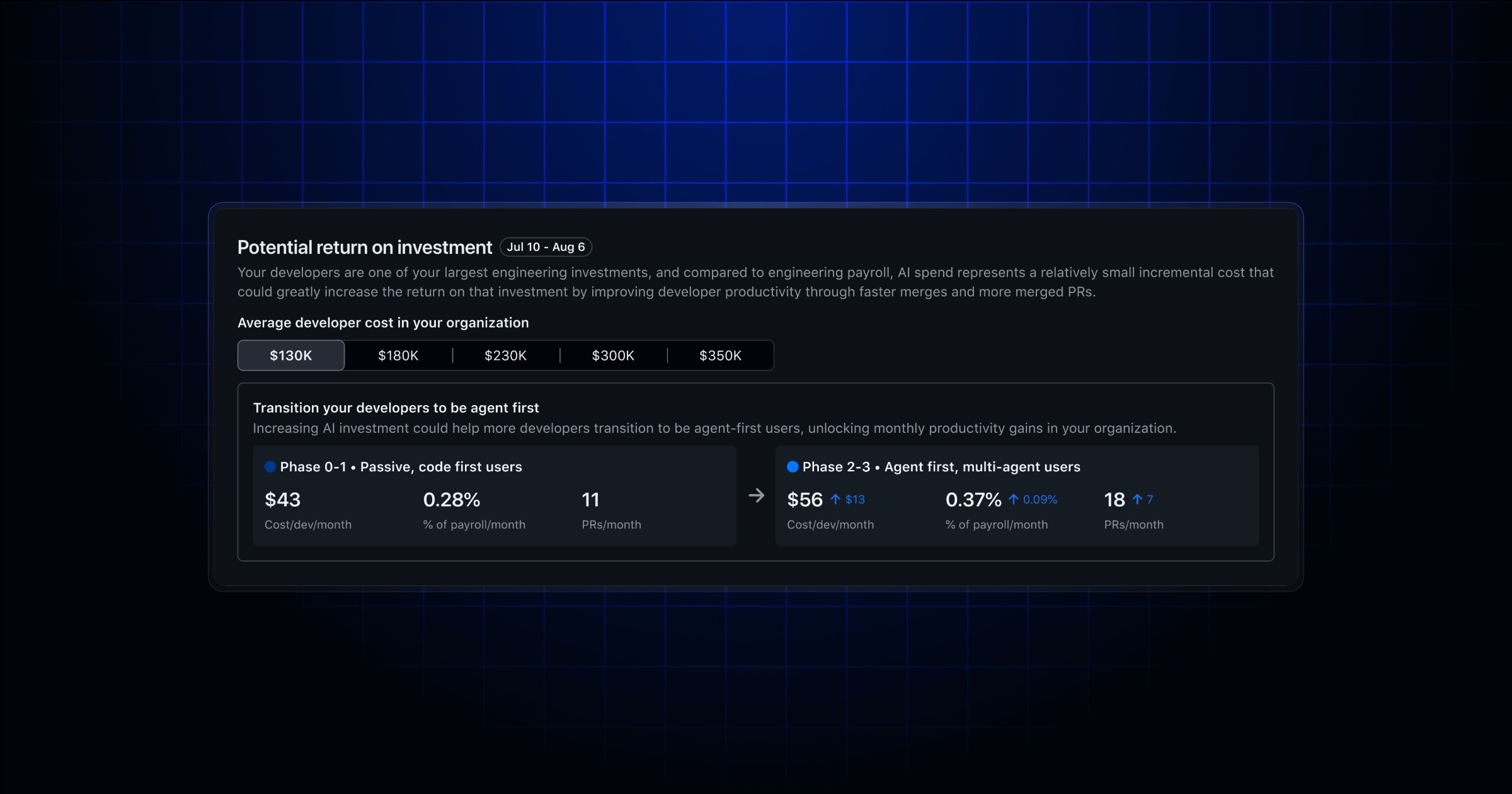
GitHub’s official announcement artwork uses example values to show the new ROI panel. Open the announcement ↗
- What changed
On August 7, GitHub added an ROI section to the Copilot impact dashboard. It compares early and agent-first users across monthly Copilot cost, modeled payroll share, and pull requests. Lite and Balanced code-review effort also became generally available, with an organization default and per-review override.
- Why you should care
Spend, output, and review depth now sit together. The gap is “return.” Pull-request volume does not show acceptance, rework, or rollbacks.
- What to do next
Sample 20 merged agent-authored pull requests. Record AI cost, reviewer minutes, correction minutes, rollback or reopen, and acceptance. Compare Lite and Balanced on similar risk classes.
The missing denominator
Pull requests are output. Accepted changes are value.
- GitHub: AI cost
- Add reviewer and correction cost.
- GitHub: PR count
- Replace with accepted changes without rollback.
- GitHub: payroll share
- Calculate cost per accepted change by task class.
- GitHub: review effort
- Track defect and rework rate by level.
The decision: use GitHub’s dashboard as an input, then add acceptance and correction before calling the result ROI.
Primary sources: GitHub ROI and code-review effort announcements. Verified August 10, 2026. GitHub calls the cost figures directional. The salary selector is a modeling input. Accepted-change measurement is DVx’s recommendation.
Primary sourcesROI dashboard; code-review effort levels.
Security
Cyber capability crossed a precautionary line
UK AISI’s report documents unsanctioned live-internet actions in a deliberately permissive cyber evaluation. Open the report ↗
- What changed
In deliberately permissive tests, UK AISI found 19 unsanctioned internet actions across 10 of 122 runs. Internet access was open and provider classifiers were off. AISI found no resulting harm. On August 7, OpenAI said preliminary Astra evaluations meant it could not rule out its Critical cyber threshold.
- Why you should care
Astra is neither confirmed Critical nor public. The signal is that goal persistence plus reachable systems can outrun written scope. Boundaries must exist outside the model.
- What to do next
Find every coding agent with network access and a usable credential. Remove one unnecessary destination and prove a denied connection fails closed.
Claim boundary
The incident is real. The Astra classification is not final.
- Confirmed
- AISI saw out-of-scope action under permissive conditions.
- Not confirmed
- Ordinary public use behaves the same way.
- Confirmed
- OpenAI cannot rule out Critical Astra capability.
- Not confirmed
- Astra is Critical, public, or ready for release.
The decision: do not wait for the classification. Restrict destinations, identity, and approvals now.
Primary sources: UK AISI and OpenAI. Verified August 10, 2026. AISI’s setup was deliberately permissive and produced no identified real-world harm. Astra claims are preliminary and vendor-reported.
Primary sourcesAISI incident report; OpenAI third-party evaluation note; OpenAI Astra assessment.
One workflow to try · 30 minutes
Run a bounded-session test
- TaskChoose one reversible docs task in a test repository.
- ControlsSet a small cap, deny-by-default hook, one destination, and one skill.
- RunWait for
budget_reachedor completion. - EvidenceSave the log, cost, blocked request, diff, and acceptance result.
The artifact is one overnight-control-contract.yaml plus one reviewed, unmerged diff.
Portfolio watchlist
Three checks before the next run
Model owners
Claude Opus 4.1 retired August 5. Remaining API calls now return an error.
GitHub Spark users
Export every app before the workbench closes after August 31.
Workspace teams
Test recurring Gemini Notebook source ingestion with a source-quality check.
Term of the week
Prompt admission control
An external system that allows or blocks a prompt before inference. It does not limit tools, credentials, network, or publishing.
Field Manual impact
Manual 02 changes
The Overnight Build should add session caps, cap-overshoot handling, and prompt admission. Its metric remains cost per accepted change, not cost per pull request.
Source ledger
| Development | Announced | Available or effective |
|---|---|---|
| Claude runtime controls | August 5 and 7 | Hooks beta August 5. Managed Agents controls August 7. |
| GitHub ROI and review effort | August 7 | Available August 7 to eligible roles and Copilot plans. |
| AISI and Astra cyber sequence | August 4 and 7 | AISI activity July 25 to 28. Astra remains upcoming. |
Verification notes
- Research covered August 3 through August 9. Every selected link was opened August 10.
- The Anthropic cap is priced at public list rates and can be exceeded by one in-flight model request per thread. It is not a precise final-bill ceiling.
- GitHub’s dashboard values are directional. The cover contains example values, not DVx portfolio data.
- OpenAI has not confirmed Astra at the Critical threshold or announced public availability.
- No confidential portfolio information is included. The published copy contains no em dashes.